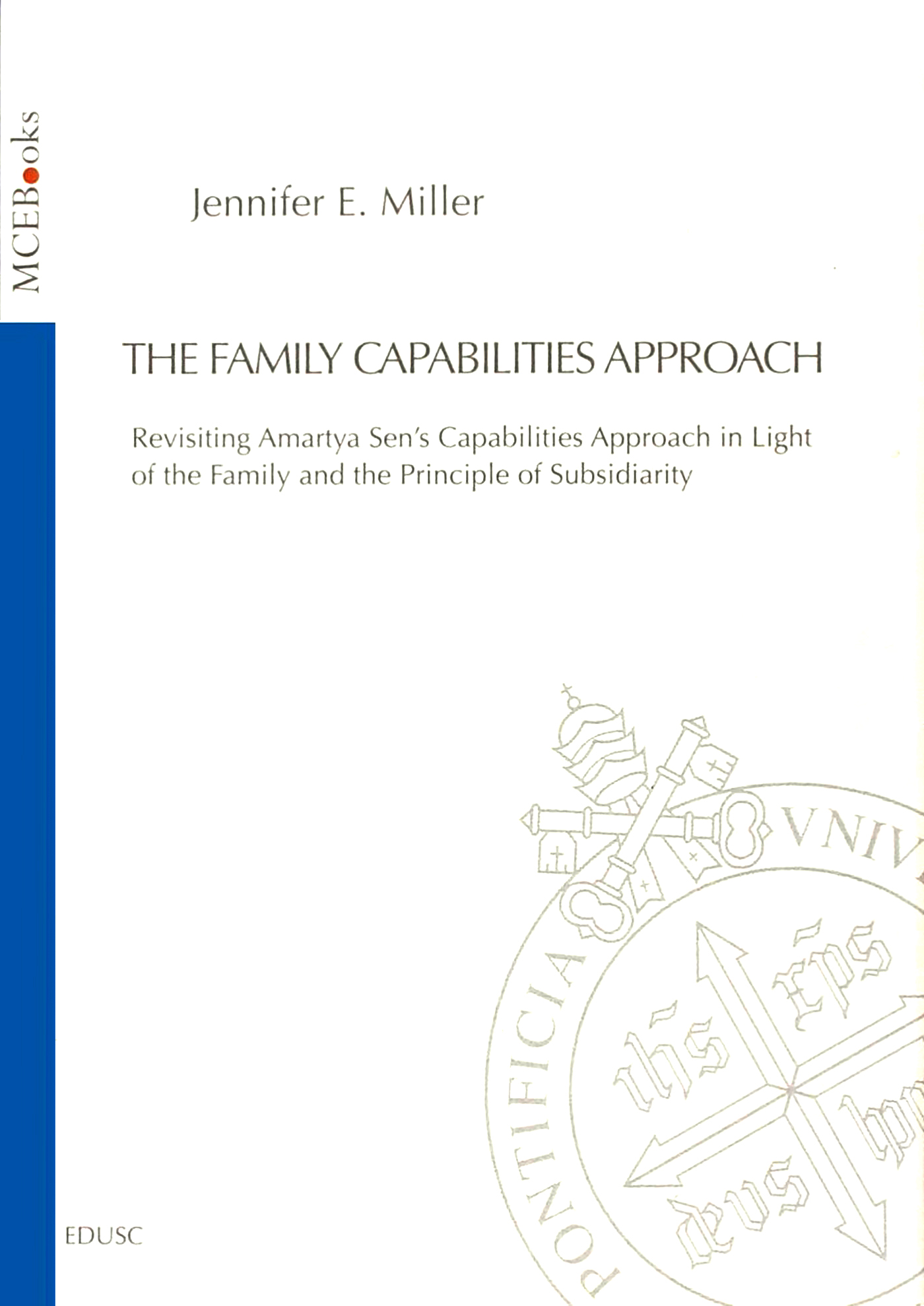
The Family Capabilities Approach
Revisiting Amartya Sen's Capabilities Approach in Light of the Family and the Principle of Subsidiarity
Jennifer E. Miller
Editore: EDUSC 2014
ISBN: 978-88-8333-329-3
Pagine: 310 pp.
Prezzo Libro: 25.00 €
Prezzo Ebook: 12.99 €

ACQUISTA

Descrizione

 What is “the good life”? How can it best be achieved? The attention of the 1998 winner of the Nobel Prize in Economics, Amartya Sen, to the human person and to the importance of realizing the good life has caused him to be described by one theologian as “the conscience of economics”. Known as the capabilities approach, his proposal, a now integral part of the United Nations Human Development Reports’ measurement of poverty, seems to ally itself with “the goal of rescuing peoples, first and foremost, from hunger, deprivation, endemic diseases and illiteracy” (Caritas in Veritate, 21), while not limiting itself to the topic of material underdevelopment but addressing the progress of society as a whole. However, a work engaging his thought with that of Catholic social doctrine has as yet been unwritten. This volume, therefore, seeks to fill that lacuna by first explaining and presenting Sen’s capabilities approach in a manner accessible to both amateur theologians and amateur economists; a simple yet thorough explanation of its basic aims and method introduce the reader into this manner of thinking about the social life. From the viewpoint of that integral human development, which is at the heart of both Populorum Progressio and Caritas in Veritate, his positive practical intuitions are then illuminated while the need for a more solid theoretical basis to ensure the good life that is truly the most human becomes more apparent. With the contributions of American and European theologians and economists, a family capabilities approach, overcoming his methodological individualism and focusing upon the family, civil society, and the principle of subsidiarity, proposes key concepts in the elaboration of “the good life” for all.

Cajun by birth, Dr. Jennifer E. Miller has studied at the Pontifical Universities of the Angelicum and the Gregorian, as well as at the John Paul II Institute for Studies on Marriage and Family in Rome, obtaining her doctorate with a thesis in moral theology at the Pontifical University of the Holy Cross. She has taught courses on moral theology and business ethics in the United States and in Italy. Currently Directress of Studies at the Markets, Culture and Ethics Research Centre at the Pontifical University of the Holy Cross, Dr. Miller’s principle areas of research are the economy and the family.

Vedi nella stessa Collana: MCE

Altre Pubblicazioni

Truth Heals

Truth Heals

For over three decades, the Catholic Church has confronted the global crisis of sexual abuse. Since the 2002 "Spotlight" investigation, important reforms have improved safeguarding, yet the work remains incomplete – especially in communications. This book explores how...

L’edificio di culto e gli artisti

L’edificio di culto e gli artisti

A venticinque anni dal primo Giubileo degli Artisti, questo volume riflette sul rapporto tra Chiesa e arte nel XXI secolo, interrogandosi su come architetti, pittori, scultori e altri protagonisti della cultura contemporanea abbiano accolto l’invito dei Pontefici a...

Gelasiana

Gelasiana

Il volume invita il lettore a riconoscere come la riscoperta del Sacramentarium Gelasianum non sia un esercizio erudito fine a se stesso, ma un vero atto di memoria viva. Nel celebrare il XXV anniversario della Facoltà di Teologia dell’Università...

Breviarium Hispano-Mozarabicum I

Breviarium Hispano-Mozarabicum I

La Iglesia vive de la Pascua de Cristo que se actualiza en la celebración de los sacramentos, sobre todo en la eucaristía, de manera especial en la celebración dominical. Y así lo ha hecho desde la época apostólica. Pronto se celebró también la memoria anual de la...

La dimensione giuridica della comunione ecclesiale

La dimensione giuridica della comunione ecclesiale

L’opera approfondisce il rapporto tra la comunione ecclesiale e il diritto canonico. Attraverso la presentazione degli approcci a questo tema di alcuni teologi e di alcuni canonisti, si offre una visione basata sulla concezione del diritto come bene giuridico.Ne...

Giornalismo e Intelligenza Artificiale

Giornalismo e Intelligenza Artificiale

Il volume raccoglie e approfondisce i contenuti della Giornata di studio e di formazione professionale per giornalisti promossa dall’Associazione ISCOM e dalla Pontificia Università della   Santa Croce, dove si è svolta il 15 aprile 2026. I cambiamenti...

Credere al Dio della vita

Credere al Dio della vita

Una lettura attenta dei primi capitoli del libro dell’Esodo, che narrano la nascita e la vocazione di Mosè, mostra che il vero protagonista degli eventi è sempre il Signore, in modo diretto, come quando appare in mezzo al roveto, oppure indiretto, in eventi che a...

El papel de la esperanza en la amistad

El papel de la esperanza en la amistad

Esta tesis doctoral investiga la conexión entre la amistad y la esperanza desde las perspectivas filosófica y teológica de Aristóteles y Santo Tomás de Aquino. El autor analiza cómo la esperanza, entendida tanto como una pasión humana que impulsa la voluntad ante...

The Invisible Divine in Christian Art

The Invisible Divine in Christian Art

This book explores how Christian art has visually communicated the invisible divine from late antiquity to the present. While sacred images and church architecture originally functioned within liturgical and devotional use, today they are often encountered by...

BeDoCare

BeDoCare

Le profonde trasformazioni che attraversano oggi il continente africano pongono nuove domande sul rapporto tra sviluppo, educazione, lavoro e responsabilità sociale.Questo volume raccoglie idee, esperienze e prospettive emerse durante la conferenza internazionale...

L’alternativa all’intelligenza artificiale

L’alternativa all’intelligenza artificiale

L’intelligenza artificiale è la cosa nuova del nostro tempo: una tecnologia che sta ridefinendo il lavoro, l’informazione e le relazioni umane. Di fronte a questa trasformazione, la questione decisiva non riguarda le macchine, ma l’uomo. La sfida che abbiamo davanti...

Teleology and Human Action

Teleology and Human Action

This book examines the role of teleology—understood as purposiveness or orientation toward ends—in shaping human action and the pursuit of a meaningful life. Centered on the philosophy of William James, it argues that his pragmatism places purposive human agency at...

Il primato del bene comune contro i personalisti

Il primato del bene comune contro i personalisti

Che cos’è il bene comune? La sommatoria dei beni individuali di un gruppo sociale? Il maggior benessere del maggior numero di persone? Oppure il bene dello Stato? Si potrebbe – e si dovrebbe – rispondere che il bene comune non corrisponde a nessuna di queste cose....

Il frutto dello Spirito

Il frutto dello Spirito

Il libro propone l’analisi letteraria e teologica del brano di Gal 5,16-26. Alla luce delle indicazioni emergenti dalla relazione tra Paolo e le comunità galate, il lettore viene introdotto nel “dinamismo demistificante” dell’esortazione paolina. Le accorate parole...